Most small business owners assume a business coach will hand them a plan, tell them what to do, and watch the results roll in. That is not what happens. The real role of business coaching is far more valuable and far less comfortable than that. It is a structured, confidential partnership that challenges how you think, sharpens how you lead, and builds the kind of capability that outlasts any single piece of advice. If you are running a business in New South Wales and wondering whether coaching is worth your time, this guide will give you an honest, specific answer.
Table of Contents
- What is business coaching and how does it differ from consulting and mentoring?
- How business coaching supports effective leadership and business growth
- Measuring the value: understanding the returns of business coaching
- Common misconceptions and critical success factors in business coaching
- How to apply business coaching effectively in your small business
- Fresh perspective: why coaching is your secret leadership asset in NSW small business
- Discover leadership coaching services tailored for NSW small businesses
- Frequently asked questions
Key Takeaways
| Point | Details |
|---|---|
| Coaching builds leadership capability | Business coaching helps you develop the skills and mindset to lead effectively and grow your business. |
| Coaching is a partnership | It’s about unlocking your own solutions through guided reflection and accountability, not quick fixes. |
| Focus on outcomes not sessions | Measure coaching’s value by sustained changes in leadership behaviours linked to business results. |
| Apply coaching strategically | Use coaching when stepping into bigger roles or facing growth challenges to accelerate leadership maturity. |
| Embed coaching culture | Making coaching a regular habit builds trust, improves feedback, and supports long-term success. |
What is business coaching and how does it differ from consulting and mentoring?
Business coaching is not consulting. It is not mentoring either. These distinctions matter because choosing the wrong type of support can leave you frustrated and no further ahead.
A consultant diagnoses a problem and delivers a solution. You pay for their expertise and walk away with a report or a recommendation. A mentor shares what worked for them, drawing on their own experience to guide you. Both have genuine value. But business coaching is a confidential, structured partnership helping leaders think clearly and take decisive action, rather than simply receiving answers from someone else.
The difference is in where the solution comes from. In coaching, it comes from you. The coach’s role is to ask the right questions, create the right conditions, and hold space for you to develop your own thinking. That process builds something consulting rarely does: genuine, lasting capability.
Here is how the three approaches compare:
| Approach | Who generates the solution | Primary focus | Best used when |
|---|---|---|---|
| Consulting | The consultant | Solving a specific problem | You need expert analysis or a deliverable |
| Mentoring | The mentor (from experience) | Sharing wisdom and guidance | You want industry insight or career direction |
| Business coaching | You (with coach’s support) | Building your thinking and leadership | You want to grow as a leader and decision-maker |
The benefits of coaching show up most clearly over time. Because you are building your own problem-solving muscles, you become less dependent on external input for every decision. That self-sufficiency is what makes leadership coaching such a powerful long-term investment.
Key things a business coach does not do:
- Tell you what decision to make
- Fix your team problems directly
- Deliver a business strategy on your behalf
- Replace your accountant, lawyer, or HR adviser
What a coach does do is help you become the kind of leader who handles all of those situations more effectively.
How business coaching supports effective leadership and business growth
Understanding the definition is one thing. Seeing how it plays out in practice is another. For small business owners in NSW, the importance of business coaching often becomes clear at a specific moment: when the business outgrows the founder’s current leadership capacity.

Business coaches often provide strategy and accountability, acting as an external thinking partner for leadership decisions rather than just operational problem-solving. That external perspective is something most small business owners simply do not have access to otherwise. Your team looks to you for answers. Your accountant focuses on numbers. A coach focuses entirely on you as a leader.
Here is how coaching typically supports growth in practice:
- Clarifying strategy. Coaching sessions create space to think beyond the day-to-day. You identify what actually matters, what you are avoiding, and where your energy is going. That clarity directly shapes better business decisions.
- Building accountability. When you commit to a goal in a coaching session, you are far more likely to follow through. The coach does not chase you, but the structured rhythm of sessions creates natural accountability that most business owners lack.
- Developing communication and delegation skills. These are the two leadership skills that most commonly hold small business growth back. Coaching surfaces the habits and beliefs that get in the way, then helps you change them.
- Preparing for bigger roles. Leadership and growth coaching is essential when leaders face expanded roles or specific challenges like communication, influence, or strategic thinking. If you are about to hire your first manager, enter a new market, or step back from day-to-day operations, coaching is the preparation most founders skip and later regret.
Pro Tip: Do not wait for a crisis to engage a coach. The best time to start is just before a significant transition, not in the middle of one when your bandwidth is already stretched.
For business owners who want to sharpen their thinking at a structural level, strategic thinking coaching provides a focused framework for exactly that.
Measuring the value: understanding the returns of business coaching
Business coaching effectiveness is often questioned because the benefits are not always visible on a spreadsheet. But that does not mean they are not measurable. It means you need to measure the right things.
Coaching can deliver very high ROI through sustained behaviour change, with examples indicating returns over 600%. That number sounds extraordinary until you consider what leadership behaviour change actually affects: staff retention, team performance, decision quality, customer relationships, and revenue.
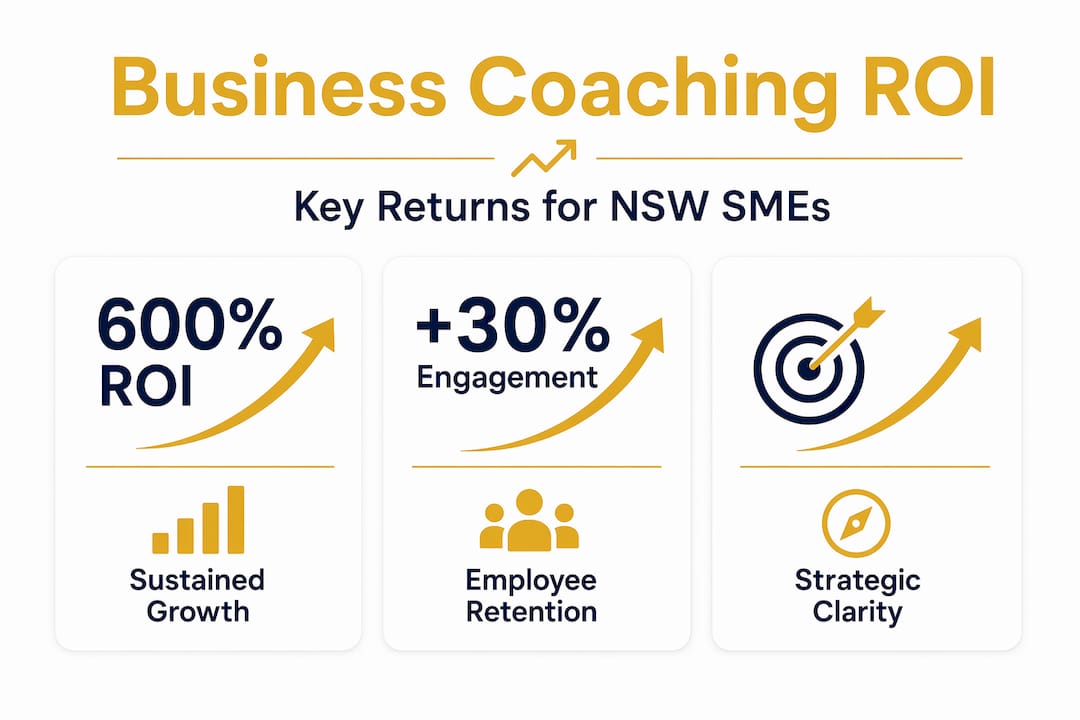
The key is in how you track it. ROI should be measured by quantifiable business impact attributable to coaching-driven behaviour change, not the number of sessions delivered.
Here is what that looks like in practice:
| Business outcome | Coaching-linked behaviour change | How to measure |
|---|---|---|
| Staff retention | Improved manager communication and feedback | Turnover rate before and after |
| Team engagement | More consistent one-on-one conversations | Engagement survey scores |
| Leadership readiness | Delegation and decision-making confidence | 360-degree feedback |
| Innovation | Psychological safety and idea-sharing culture | Number of initiatives generated |
“The most powerful coaching outcomes are not visible in the first month. They show up six months later when a leader handles a difficult conversation differently, makes a faster decision, or retains a key team member they would have previously lost.”
To build a credible case for coaching investment, start with baseline data before you begin. Note where your leadership gaps are, what your team feedback looks like, and what business metrics are underperforming. Then revisit those same measures after three to six months of business coaching support.
Common misconceptions and critical success factors in business coaching
The biggest misconception about coaching is that it is a fast solution. Business owners often expect coaching to immediately fix performance. In reality, the power lies in dialogue and self-generated solutions, not in receiving ready-made answers from someone else.
That expectation gap is why some coaching engagements underdeliver. The owner wants a prescription. The coach keeps asking questions. Frustration builds. The real issue is a misalignment of expectations, not a failure of the coaching process.
Here is what actually makes coaching work:
- Clear, observable goals. Vague goals like “be a better leader” produce vague results. Effective coaching requires translating vague problems into observable behaviours with structured review windows to track progress. “Deliver clear feedback to my team within 48 hours of a performance issue” is a goal you can track.
- Commitment to the process. Coaching requires you to show up prepared, be honest about what is not working, and act on what you discover between sessions. Half-hearted participation produces half-hearted results.
- Consistency over time. One or two sessions will not shift deeply ingrained leadership habits. A recurring rhythm of sessions, typically fortnightly or monthly, builds the kind of momentum that creates lasting change.
- Psychological safety. The coaching relationship only works when you feel safe enough to be genuinely honest. That means choosing a coach whose style and values align with yours, not just their credentials.
Pro Tip: Before your first coaching session, write down three leadership behaviours you want to change and three business outcomes you want to improve. Bring that list to the conversation. It transforms a general coaching discussion into a focused, results-oriented engagement.
If you are also thinking about how coaching principles can extend to your team, team and culture coaching explores how to embed those habits organisation-wide.
How to apply business coaching effectively in your small business
Knowing why coaching matters is useful. Knowing exactly when and how to use it is what makes the difference. Here is a practical framework for applying coaching in your NSW small business.
- Identify your trigger. Coaching is especially valuable when stepping into larger leadership roles or facing complex growth challenges. Common triggers include hiring your first manager, losing a key team member, hitting a revenue ceiling, or receiving consistent feedback about your communication style.
- Set specific objectives before you start. What do you want to be able to do differently in three months? Be concrete. “Improve how I run team meetings” is more useful than “become a better communicator.”
- Commit to a structured schedule. Structured one-on-one coaching sessions with clear objectives help move people from one competency level to another. Block the time. Treat it like a board meeting, not something you reschedule when things get busy.
- Act between sessions. Coaching only works if you apply what you discover. Each session should end with one or two specific actions you will take before the next. Those actions are where the real growth happens.
- Review progress at regular milestones. Every six to eight sessions, step back and assess. Are you making the changes you set out to make? Are those changes affecting your business? Adjust your focus if needed.
Pro Tip: Share your coaching goals with a trusted team member or business partner. Not the details of your sessions, but the behavioural outcomes you are working toward. Their feedback over time becomes some of the most valuable data you have.
The leadership coaching approach that works best for small business owners is one that stays grounded in real business context, not abstract leadership theory.
Fresh perspective: why coaching is your secret leadership asset in NSW small business
Here is something most coaching articles will not tell you. The majority of small business owners in Australia did not choose to become leaders. They chose to start a business. Leadership came with the territory, often without warning, preparation, or support.
Many small business owners become accidental managers who lack formal leadership training, making coaching crucial for developing true leadership skills. That phrase, “accidental manager,” captures something real. You were brilliant at your craft, so you started a business. Then suddenly you were responsible for other people’s livelihoods, team culture, and organisational direction. Nobody trained you for that.
This is where the role of a business coach becomes genuinely transformative, not just useful. The shift coaching creates is not just about skills. It is about identity. The person who learns to delegate effectively is not just someone who has mastered a technique. They have changed how they see themselves as a leader. That identity shift is what sustains the behaviour long after the coaching engagement ends.
Great coaching involves intuitive, tailored questioning that helps leaders find solutions aligned to their vision and values rather than providing pre-made answers. The best coaches do not have a formula. They listen at a level most people never experience in a business context, and they ask the question that cuts through the noise and lands on what actually matters.
There is also a multiplier effect worth considering. When you develop a coaching mindset as a leader, you start to coach your own team. You ask better questions instead of jumping to answers. You create space for people to think rather than just execute. That shift in how you lead changes your culture. And culture, more than any strategy or system, is what determines whether your business can grow beyond you.
Building that kind of environment is exactly what building coaching culture within a business is designed to support.
Discover leadership coaching services tailored for NSW small businesses
If this article has clarified what coaching actually is and what it can do for your business, the next step is finding the right support to make it real.

At Elevate Biz Advisory, we work with small business owners across New South Wales through honest dialogue, practical coaching, and leadership development that focuses on the human side of performance. Because when people grow, business follows. Whether you are ready to invest in leadership coaching services tailored to your specific growth goals, want to explore team and culture support that embeds coaching principles across your organisation, or need strategic thinking coaching to sharpen your decision-making, our coaches provide structured, practical support built for where you actually are, not where a textbook says you should be.
Frequently asked questions
What exactly does a business coach do for a small business owner?
A business coach partners confidentially with you to help clarify your thinking, set goals, and stay accountable, so you can develop stronger leadership skills and make better decisions. Rather than providing answers, coaching helps leaders think clearly and take decisive action on their own terms.
When should I consider hiring a business coach?
Consider coaching when stepping into a bigger leadership role, facing growth challenges around communication or strategy, or when consistent feedback points to leadership gaps. Coaching is recommended when leaders face expanded responsibilities requiring new skills and approaches.
How can I measure if business coaching is delivering value for my company?
Track behavioural changes linked to business outcomes such as employee retention, engagement scores, leadership readiness, and performance improvements rather than counting how many sessions you have attended. ROI should focus on sustained behaviour change impacting business metrics.
Is business coaching just for large companies or executives?
No. Small business owners benefit enormously from coaching, often more than executives who already have formal leadership development programmes. Coaching is widely used across different leadership stages, including small business owners and emerging leaders who are building capability in real time.
